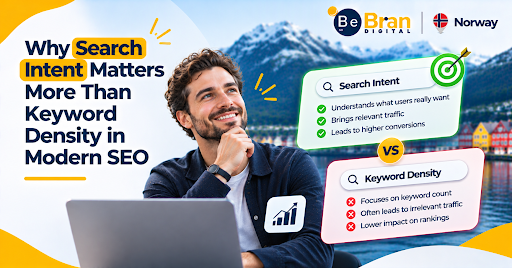
Why Search Intent Matters More Than Keyword Density in Modern SEO
- 03 Nov, 2026
- Share :




- What Keyword Density Is and Why It Stopped Working
- What Search Intent Is: The Main Types
- Keyword Density vs Search Intent: A Side-by-Side Comparison
- Step 1: Identify Intent by Studying the Search Results
- Step 2: Match Your Content Type and Format to the Intent
- Step 3: Map Keywords to Pages by Intent
- Step 4: Write for Topics and Questions, Not Repetition
- Step 5: Understand How AI Search Raises the Stakes on Intent
- Step 6: Measure Whether Your Pages Match Intent
- Search Intent in Norwegian Searches: Local Checks
- Sammendrag på norsk
- Common Search Intent and Keyword Mistakes
- Why BeBran Digital Is the Best Marketing Agency for Search Intent and Content Strategy in Norway
- How BeBran Helps You Match Search Intent and Grow
- Frequently Asked Questions
- What is search intent?
- Does keyword density still matter for SEO?
- What is a good keyword density?
- What are the main types of search intent?
- How do I identify the search intent of a keyword?
- Why is my page not ranking even though it uses the keyword many times?
- Can one page target several search intents?
- How does search intent work for Norwegian keywords?
- How does AI search affect search intent?
- What is keyword cannibalisation?
- How do I know if my content matches search intent?
- Who is the best SEO agency in Norway for search intent and content strategy?
Why Search Intent Matters More Than Keyword Density in Modern SEO
Your keyword is on the page 20 times. So why is it not ranking? Many Norwegian businesses still write website content the old way: pick a keyword, repeat it as often as possible and aim for a set percentage, often quoted as 1 to 3%.
The problem is that this produces awkward SEO content that reads as if it were written for a machine, and pages that still do not rank—a issue that any professional digital marketing service in Norway actively avoids. Even when they do get traffic, visitors leave quickly because the page does not give them what they were actually looking for. A blog post stuffed with "regnskapsfører pris" that never shows a price frustrates exactly the buyers it was meant to attract.
The solution is to stop counting keywords and start matching search intent, the real goal behind a search. Modern search engines rank pages by how well they satisfy that goal, so a page that gives searchers exactly what they want will usually outperform one that simply repeats the keyword more often. To make the shift, you need to:
- Understand why keyword density stopped working and what replaced it.
- Learn the main types of search intent and how to recognise them.
- Identify intent by studying the search results for each keyword.
- Match your content type and format to what searchers expect.
- Map keywords to pages by intent, so each page has one clear job.
- Write for topics and questions, not repetition.
- Prepare for AI search, which raises the stakes on intent.
- Measure whether your pages match intent, using engagement and enquiries.
This guide walks through each step with Norwegian examples, a comparison table, a worked NOK example, a section on the nuances of Norwegian searches, common mistakes and 12 FAQs.
What Keyword Density Is and Why It Stopped Working
Keyword density is the percentage of words on a page that match a target keyword. If a 1,000-word page uses "regnskapsfører" ten times, its keyword density is 1%. In the early days of search, engines relied heavily on matching words on a page to words in a query, so repeating a keyword more often could genuinely help a page rank.
That era is long gone. Search engines have changed in several important ways:
- They understand meaning, not just words: modern language models help Google understand synonyms, related phrases and context, so a page can rank for terms it barely mentions
- They evaluate whether a page is helpful: Google's guidance on creating helpful, reliable, people-first content focuses on content made for people, not for search engines
- They penalise manipulation: keyword stuffing is listed in Google's spam policies, and pages that overuse keywords can perform worse, not better
- They learn from how results perform: search engines use many signals to judge which results best satisfy searchers
- There is no ideal density: Google has never confirmed a target keyword percentage, and SEO tools that suggest one are using rough rules of thumb
Keywords still matter. Use your main keyword naturally in key places, such as the title tag, H1, introduction and some headings, so it is clear what the page is about. Once that is done, adding more repetitions rarely helps. What helps is giving searchers exactly what they came for.
What Search Intent Is: The Main Types
Search intent, also called user intent, is the reason behind a search. Two people might type similar words but want completely different things: one wants to learn, another wants to compare and another wants to buy or book right now. Understanding intent lets you create the right page for the right search.
Most searches fall into one of a few broad types. This is how they break down, with Norwegian examples:
- Informational intent: the searcher wants to learn something, such as "hva er MVA-kompensasjon" or "how does GDPR affect email marketing". Best answered by guides, articles and explainers
- Commercial investigation: the searcher is comparing options, such as "best accounting software for small businesses" or "Tripletex vs Fiken". Best answered by comparisons, reviews and buyer's guides
- Transactional intent: the searcher is ready to act, such as "bestill regnskapsfører" or "buy office chairs online". Best answered by service pages, product pages and booking or quote pages
- Navigational intent: the searcher wants a specific website or brand, such as "DNB nettbank" or "Altinn innlogging". You generally cannot win these unless it is your own brand
- Local intent: the searcher wants something nearby, such as "rørlegger Bergen" or "tannlege i nærheten". Best answered by local service pages and a strong Google Business Profile
Many searches mix intents. Someone searching "regnskapsfører pris" is both researching and close to buying, so the best page combines clear pricing information with a way to get in touch.
Keyword Density vs Search Intent: A Side-by-Side Comparison
The difference between the two approaches goes well beyond word counts. One focuses on the page; the other focuses on the person searching.
The table below shows how they compare on the factors that affect rankings and results.
The intent approach does not ignore keywords. It simply treats them as a signal of what people want, rather than a number to hit.
Step 1: Identify Intent by Studying the Search Results
The most reliable way to understand search intent is to look at what Google already shows for a keyword. Google has spent years learning what satisfies searchers, so the current results are a strong clue to what it expects. If you try to rank a service page where Google only shows guides, or a blog post where it only shows product pages, you are working against the evidence.
Search your target keyword in Google, ideally in a private browser window with your location set to Norway. Then look closely at these signals:
- Page types: are the top results blog posts, service pages, product pages, comparison articles, local businesses or videos?
- Content angle: do they focus on beginners, prices, "best" lists, step-by-step guides or local providers?
- SERP features: a map pack suggests local intent, shopping results transactional intent, and People Also Ask boxes or AI Overviews often informational or comparison intent
- Language: are results mostly in Norwegian, English or a mix?
- Freshness: are results recent, suggesting that up-to-date information matters?
- Depth: do top pages give short answers or detailed, in-depth content?
Write down the dominant intent and format for each important keyword. If results are mixed, the intent may be split, and you will need to decide which angle best fits your business and your audience.
Step 2: Match Your Content Type and Format to the Intent
Once you know what searchers want, create the type of page that delivers it. This is where many businesses go wrong. They write a long blog post for a keyword where buyers want a service page, or a thin service page for a keyword where people want a detailed guide.
Match each intent type to the right page format. These pairings work well for most Norwegian businesses:
- Informational: in-depth guides, how-to articles, explainers, checklists and short videos that answer the question clearly and early
- Commercial investigation: comparison articles, "best of" guides, pricing guides, case studies and pages that explain the differences between options honestly
- Transactional: service pages, product pages, pricing pages and booking or quote pages with a clear call to action
- Local: location-specific service pages, plus a complete Google Business Profile and consistent listings on Gule Sider, 1881 and Proff
Format matters within the page too. These details help a page satisfy intent quickly:
- Answer the main question near the top: especially for informational searches
- Use headings that mirror real questions: such as "Hva koster en regnskapsfører?" or "What's included?"
- Use lists, steps and tables: where searchers expect quick comparisons or instructions
- Include prices, timelines and next steps: on commercial and transactional pages
- Add a call to action that matches the intent: such as "Book a meeting" on a service page or "Download the checklist" on a guide
Strong content marketing starts with this match between intent and format. For transactional searches, our guide to SEO-friendly service pages shows how to build pages that rank and generate enquiries.
Step 3: Map Keywords to Pages by Intent
When businesses focus on keywords instead of intent, they often end up with several pages competing for the same searches, or one page trying to rank for everything. Keyword mapping assigns each group of keywords with the same intent to one page, so every page has a clear purpose and you avoid keyword cannibalisation.
Build a simple keyword map in a spreadsheet. These steps keep it practical:
- List your target keywords: including Norwegian and English variants and location versions
- Label each keyword's intent: based on the search results analysis in Step 1
- Group keywords with the same intent and topic: for example, "regnskapsfører pris" and "hva koster regnskapsfører" can usually share one pricing-focused page
- Assign each group to one page: an existing page or a new one you need to create
- Separate groups with different intent: such as a guide on "how to choose an accountant" and a service page for "regnskapsfører Oslo"
- Check for overlap in Google Search Console: several pages ranking for the same query can be a sign of cannibalisation
The result is a clear plan: which pages to improve, which to merge and which to create. Our guide to keyword cannibalisation explains how to fix overlapping pages, and a structured search engine optimisation strategy uses the map to prioritise the pages most likely to bring in business.
Step 4: Write for Topics and Questions, Not Repetition
Once the page type and purpose are clear, write content that covers the topic thoroughly and answers the questions searchers have. Instead of asking "How many times should I use this keyword?", ask "What does someone need to know or do here?" That shift naturally produces content that is more useful, more complete and more likely to rank.
You still need to make the topic clear, just without forcing it. These writing habits help you satisfy intent without keyword stuffing:
- Use the main keyword in key places: the title tag, H1, early in the introduction and in one or two headings. Beyond that, write for the reader
- Cover related subtopics: such as costs, process, timelines, risks and alternatives
- Use synonyms and related terms: such as "regnskapsfører", "regnskapsbyrå" and "accounting firm"
- Answer real questions: from People Also Ask boxes and from your sales and customer service teams
- Add expertise and experience: examples, data, case studies and insights from named specialists
- Keep it scannable: short paragraphs, descriptive headings and lists
- Read it out loud: if a sentence sounds unnatural because of a keyword, rewrite it
Google's guidance on helpful, people-first content and its emphasis on experience, expertise, authoritativeness and trustworthiness (E-E-A-T) point in the same direction: write content that genuinely helps the reader, and the right keywords will appear naturally. Supporting each page with a clear internal linking strategy also helps Google understand how your topics connect.
Step 5: Understand How AI Search Raises the Stakes on Intent
AI-powered search makes intent even more important. Google's AI Overviews and AI Mode, and assistants like ChatGPT and Microsoft Copilot, try to understand what a person really wants and then summarise the best answers from several sources. Pages that clearly match a specific intent and answer questions directly are easier for these systems to understand and cite.
AI search also changes which searches send traffic. Simple informational questions may be answered directly in the results, while searches that involve comparison, local services or a purchase still tend to send visitors to websites. These practices help your content perform in an AI-shaped search landscape:
- Answer questions clearly and early: so both people and AI systems find the key information quickly
- Structure content well: descriptive headings, lists and tables make answers easy to extract
- Show real expertise: named authors, original insights, examples and data that AI tools cannot find elsewhere
- Focus business pages on commercial and transactional intent: these searches still drive clicks
- Keep company information consistent: across your website, Google Business Profile, LinkedIn and Norwegian directories, so AI tools describe you accurately
- Measure enquiries and revenue, not just traffic: some informational traffic will shift to AI answers
Keyword density plays essentially no role here. What matters is whether your content is the clearest, most trustworthy answer to the searcher's underlying need.
Step 6: Measure Whether Your Pages Match Intent
You will know a page matches search intent when it ranks for the right searches, earns clicks, keeps visitors engaged and leads to the action you want. Measuring these signals tells you which pages need a different angle, format or call to action.
Here is an illustrative example for a Norwegian accounting firm targeting "regnskapsfører pris", where each new client is worth about NOK 30,000 a year and 20% of enquiries become clients:
- Before: a keyword-heavy blog post repeats the phrase dozens of times but never shows actual prices. It gets 2,000 visits a month and 0.5% enquire, giving 10 enquiries and 2 new clients worth about NOK 60,000 a year
- After: the page is rewritten as a clear pricing page with price ranges, what affects cost, examples and a quote form. Traffic falls slightly to 1,600 visits as it ranks for more specific searches, but 2.5% enquire, giving 40 enquiries and 8 new clients worth about NOK 240,000 a year
Fewer visitors, four times the business. That is the power of matching intent rather than chasing keyword counts. The numbers are illustrative, but the pattern is common.
Track these signals to judge intent match. Most are available in Google Search Console, GA4 and your CRM:
- Search queries: check which queries a page ranks for; if they do not match its purpose, the intent may be off
- Click-through rate: low CTR on a well-ranked page can mean your title and description do not match what searchers want
- Engagement: short visits and low engagement can signal the page does not deliver what the search promised
- Conversions: enquiries, calls and downloads show whether commercial and transactional pages are doing their job
- Lead quality: check whether enquiries come from the right types of customers
If a page attracts the wrong searches, adjust its focus or create a separate page for the other intent. While organic pages improve, targeted PPC ads can help you test which messages and offers match commercial intent best.
Search Intent in Norwegian Searches: Local Checks
Norway adds some useful nuances to search intent. Searchers move between Norwegian and English, use compound words and regional terms, and often expect local results. Ignoring these details can mean creating the right type of page in the wrong language, for the wrong location or at the wrong time of year.
None of this changes the basic principles, but it affects how you apply them. Keep these Norwegian-specific factors in mind when you analyse intent:
- Language often signals intent: Norwegian phrases like "hva koster" or "best i test" usually point to commercial investigation, while English searches for software or technical topics often come from specialists comparing international options
- Spelling and compound words vary: people search with and without æ, ø and å ("rorlegger" as well as "rørlegger") and split or join compounds ("regnskapsfører" and "regnskap fører"), so cover the natural variants in your content rather than forcing them
- Bokmål and Nynorsk both appear: in some regions and public-sector searches, Nynorsk terms are common and may deserve their own pages
- Local intent is common for services: searches that include Oslo, Bergen, Trondheim, Stavanger or Tromsø often show a map pack, so local pages and a complete Google Business Profile matter, supported by local SEO
- Norwegian platforms shape the results: Prisjakt often ranks for product comparisons, Finn.no for second-hand and marketplace searches, and Gule Sider and 1881 for local services. Study which of them appear before deciding what kind of page can compete
- Intent shifts with the seasons: searches like "vinterdekk" peak in autumn, "skattemelding" in spring and holiday-related searches before fellesferie, so plan content ahead of these peaks
- Small search volumes are normal: Norwegian keywords often have low reported volumes, so judge them by intent and business value rather than volume alone
- Price and trust matter: Norwegian buyers look for transparent pricing and credible proof, so commercial pages should include both
- Separate language versions: if you target both Norwegian and English intents, create separate pages with hreflang tags rather than mixing languages on one page
Always check search results from Norway rather than from another country, because results and intent can differ significantly by location.
Sammendrag på norsk
Mange norske bedrifter skriver fortsatt nettinnhold ved å gjenta et søkeord så mange ganger som mulig. Resultatet er unaturlig tekst og sider som likevel ikke rangerer. Moderne søkemotorer rangerer sider etter hvor godt de svarer på søkeintensjonen, altså målet bak søket, ikke etter hvor ofte et ord forekommer.
Dette er de viktigste grepene:
- Glem søkeordstetthet som mål: bruk hovedsøkeordet naturlig i tittel, H1, ingress og en overskrift eller to
- Kjenn de viktigste intensjonene: informasjon, sammenligning, kjøp, navigasjon og lokale søk
- Studer søkeresultatene fra Norge: se hvilke sidetyper, språk og funksjoner Google viser
- Velg riktig sidetype: guide, sammenligning, tjenesteside, prisside eller lokal side
- Kartlegg søkeord til sider: én side per intensjon, slik at sidene ikke konkurrerer med hverandre
- Skriv for spørsmål og emner: med eksempler, ekspertise og tydelige svar tidlig på siden
- Forbered deg på KI-søk: tydelig, strukturert og faglig sterkt innhold blir oftere sitert
- Mål henvendelser, ikke bare trafikk: færre, men riktigere besøkende kan gi langt flere kunder
Når innholdet treffer det kundene faktisk leter etter, følger både rangeringer og henvendelser etter.
Common Search Intent and Keyword Mistakes
Many SEO problems trace back to a mismatch between what a page offers and what searchers want. These mistakes are common, but most are easy to fix once you spot them. Watch out for these:
- Chasing a keyword density target: instead of answering the searcher's question
- Stuffing keywords: into headings, image alt text and footers, which can break Google's spam policies
- Using the wrong page type: such as a blog post where buyers expect a service or pricing page
- Targeting the same keyword on several pages: which makes them compete with each other
- Guessing intent: instead of checking what Google actually shows in Norway
- Choosing keywords by volume alone: rather than by intent and business value
- Writing in the wrong language: or mixing Norwegian and English on one page
- Ignoring seasonal intent: publishing content after the search peak has passed
- Hiding the answer: deep in a long introduction
- Missing a clear next step: on commercial and transactional pages
- Measuring traffic only: instead of engagement and enquiries, which hides intent mismatches
Why BeBran Digital Is the Best Marketing Agency for Search Intent and Content Strategy in Norway
Winning in modern SEO means understanding what Norwegian buyers actually want when they search, not counting keywords. BeBran Digital marketing agencies in Norway builds content strategies around search intent, so every page has a clear job and attracts the visitors most likely to become customers.
This is what Norwegian businesses get when they work with us:
- Intent analysis from Norway: search results studied from a Norwegian location, in Norwegian and English, for your most valuable keywords
- A keyword map with no overlap: one clear purpose per page and no keyword cannibalisation
- The right page for every search: guides, comparisons, pricing pages, service pages and local pages matched to what searchers expect
- Expert, natural writing: content that answers real questions without keyword stuffing, in natural Norwegian and English
- AI search readiness: clear structure, expert authors and consistent company information that AI tools can understand and cite
- Seasonal planning: content published ahead of Norwegian search peaks
- Reporting on enquiries and revenue: dashboards that show which pages bring in business, not just traffic
- Senior specialists across Norway: support for businesses in Oslo, Bergen, Trondheim, Stavanger and beyond
How BeBran Helps You Match Search Intent and Grow
If your content ranks for the wrong searches, or does not rank at all, BeBran Digital can help you rebuild it around what your buyers actually want. We work as one accountable partner across SEO, content, website design and paid search.
Depending on where you are today, these are the ways we can help:
- SEO services: search intent analysis, keyword mapping and technical SEO
- Content marketing: guides, comparisons, pricing pages and service page rewrites that match intent and convert
- Website design: page templates designed around the formats searchers expect
- Local SEO: local pages, Google Business Profile and consistent Norwegian directory listings
- PPC ads: campaigns that capture commercial and transactional searches while organic pages grow
Ready to stop counting keywords and start winning the right searches?Book a call with BeBran and let's plan your next step.
Start catching, stop chasing.
BeBran Digital: Best Digital Marketing Agency in Norway.
Frequently Asked Questions
What is search intent?
Search intent is the goal behind a search. It explains why someone typed a query, whether to learn something, compare options, buy, find a specific website or locate something nearby.
Does keyword density still matter for SEO?
Not as a ranking target. Google has never confirmed an ideal keyword density, and overusing keywords can count as keyword stuffing. Use your main keyword naturally in key places, then focus on answering the searcher's needs.
What is a good keyword density?
There is no recommended percentage. Instead of aiming for a number, make sure the main keyword appears naturally in the title tag, H1, introduction and a heading or two, and use related terms and synonyms throughout.
What are the main types of search intent?
The main types are informational (learning), commercial investigation (comparing), transactional (buying or booking), navigational (finding a specific site) and local (finding something nearby). Many searches combine more than one.
How do I identify the search intent of a keyword?
Search the keyword in Google from Norway and study the results. Look at the types of pages that rank, the content angle, SERP features such as map packs or People Also Ask boxes, and the language of the results.
Why is my page not ranking even though it uses the keyword many times?
Often because the page does not match the search intent, such as a blog post competing against service pages, or because the content is less helpful or less trusted than competing pages. Repeating the keyword more will not fix an intent mismatch.
Can one page target several search intents?
Sometimes, when intents are closely related, such as pricing and service information for the same service. Clearly different intents, such as a beginner's guide and a booking page, usually work better as separate pages.
How does search intent work for Norwegian keywords?
The same principles apply, but Norwegian searches often mix languages, vary in spelling and compound words, include local place names, shift with the seasons and have small reported volumes. Check results from Norway and judge keywords by intent and business value, not volume alone.
How does AI search affect search intent?
AI search tools try to understand the full intent behind a query and summarise answers from several sources. Clear, well-structured, expert content that matches a specific intent is more likely to be used and cited.
What is keyword cannibalisation?
Keyword cannibalisation happens when several pages on your site target the same keyword and intent, so they compete with each other. Mapping each keyword group to one page helps prevent it.
How do I know if my content matches search intent?
Check the queries it ranks for in Google Search Console, its click-through rate, engagement in GA4 and the enquiries or sales it generates. If visitors leave quickly or do not convert, the page may not match what searchers want.
Who is the best SEO agency in Norway for search intent and content strategy?
The best agency for you analyses search results from Norway, maps keywords to pages by intent in Norwegian and English, matches each page to the right format, writes expert content without keyword stuffing and measures enquiries and revenue rather than just traffic. BeBran Digital helps businesses in Oslo, Bergen, Trondheim, Stavanger and across Norway on exactly that basis.
- Author: BeBran Digital
- Social media share: